Monday, July 20, 2015

Heavy Rains May Cause Plant Problems

Image of a webshot of a drought map
Drought maps for the 2nd week in July -
2015 (top) and 2013 (bottom)
(http://droughtmonitor.unl.edu)
Heavy rains may cause plant problems for crop producers and homeowners – The recent heavy rains across much of New Mexico are helping to relieve drought conditions, however, a lot of water in a short period of time can cause problems for plants - especially when rain hits the same area with different storms over a short period of time. Plant diseases caused by microorganisms that require significant amounts of moisture and/or high humidity are usually limited by New Mexico’s typically dry climate. However, when environmental conditions favorable for disease development occur, it doesn’t take long for these pathogens to cause problems. Over the past few weeks, heavy rains have hit much of New Mexico and plants are beginning to show symptoms of disease. Native plants and xeric plants can be especially vulnerable to excessive moisture events. Diseases that are favored by these conditions include foliar diseases and root and crown rots, but plant pathogens aren’t always the cause of problems following excessive moisture. Roots may become dysfunctional from a lack of oxygen in the soil. Blackening or blighting of leaves, flowers and stems is a common symptom caused by many different organisms that cause foliar diseases. Plants growing close together or in locations with poor air circulation are especially susceptible to attack by microorganisms. Plants weakened by other environmental stress or other pests are also more susceptible. Plants which have been experiencing prolonged drought are especially vulnerable to root rot when the roots are exposed to excessive amounts of water. The long term damage caused by foliar diseases depends on the situation. Annual plants may die or become unsightly earlier than expected. Perennial plants that are going to shed leaves later in the fall may suffer little permanent damage to the plant, depending on how much of the plant is affected and how early in the growing season the damage occurs. Plants with root or vascular problems usually develop stem or branch dieback or die. Plants that were stressed due to other conditions before the heavy rains may succumb to the cumulative stresses.


A composite photo showing yellow bird of paradise with white fungus on the leaves.
Powdery mildew on yellow bird of paradise,
Caealpinia gilliesii
(Photo: NMSU-PDC)

A composite photo showing black decaying plant tissue.
Foliar blight on purple coneflower,
Echinacea purpurea (Photo: NMSU-PDC)

A composite photo showing pomegranate fruit splitting open before ripening.
Premature fruit splitting can be caused by irregular water or too much water arriving
at a critical growing point during fruit development. This causes parts of the
fruit to ripen at different rates resulting in split, ruined fruit. (Photo: NMSU-PDC)

Sunday, July 19, 2015

Common Purslane: A Troublesome Summer Annual Weed

A photo of a weed growing on the ground
Common purslane is a weed of crevices between
bricks, in cracked cement, or compacted, low nutrient
soils. It also can be found in most cultivated crops,
gardens, lawns, and landscape beds (Photo: NMSU)
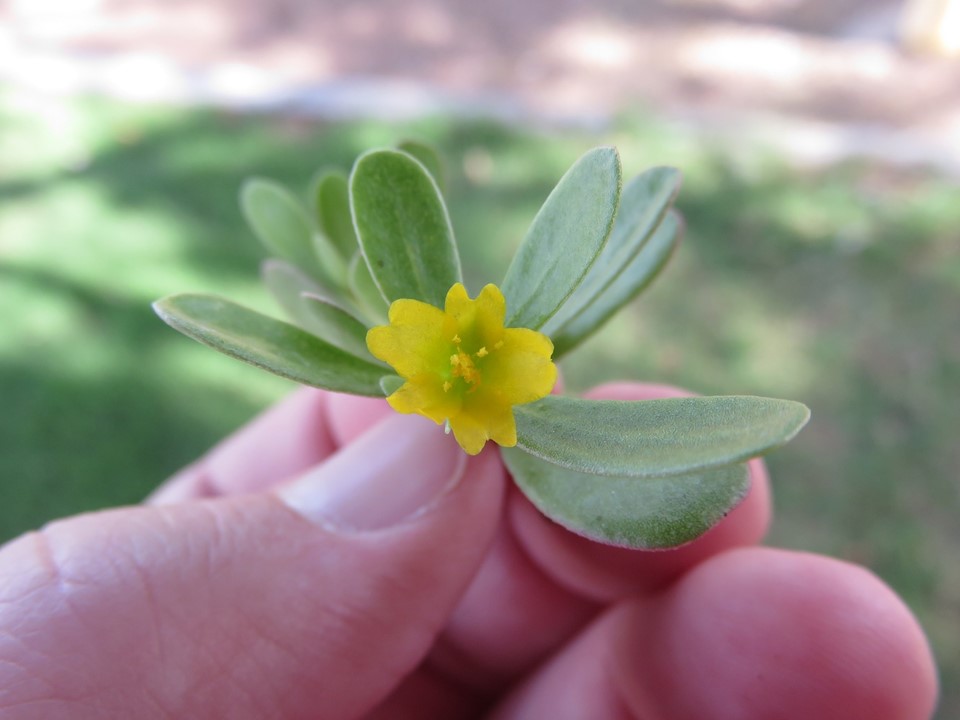
Featured Diagnosis: Common purslane (Portulaca oleracea) is a summer annual with a prostrate, mat-forming growth habit and thick, succulent stems and leaves. The plant germinates from seed during the warmer summer months (from March until August) and is a troublesome weed in cultivated fields, gardens, and landscapes throughout New Mexico. It is easily identified by its’ smooth reddish or flesh colored stems along with leaves that are succulent, shiny, green with maroon tinges, almost teardrop shaped, and wider at the tip than at the base. In late summer, the plant produces bright yellow flowers that have five petals and are only open when it is sunny. The plant also produces large amounts of viable black seeds that are produced in fleshy capsules that resemble unopened flower buds. These seeds have the ability to remain viable in the soil for multiple years before germinating.

Close-up of a plant with shiny, succulent, teardrop-shaped leaves
Common purslane can be identified by it's smooth
reddish stems and shiny, succulent, teardrop-shaped
leaves (Photo: NMSU)

Close-up of the bright yellow flower of common purslane
The bright yellow flowers of common purslane
are only open when sunny (Photo: NMSU)


Close-up of a fleshy seed pod of common purselane
Fleshy pods open at maturity to release multiple
tiny black seeds into the soil (Photo: NMSU)

Thursday, July 16, 2015

Cucumber Mosaic Virus on Vegetable Plants

Curled and deformed pepper leaves at the terminal of a branch
CMV on chile pepper (Photo: NMSU-PDC)
Deformed tomato plant infected with virus
CMV on tomato (Photo: NMSU-PDC)
Featured Diagnosis - Cucumber Mosaic Virus. Are some of your vegetable plants deformed, twisted or elongated? Are the leaves mottled, wrinkled or curled? Are the plants stunted and not producing any fruit? If you answered yes to any of these questions, then your plants may be suffering from Cucumber Mosaic Virus (CMV). This is a common virus, worldwide, and is present every year in New Mexico. CMV can cause a wide range of symptoms depending on host, age of the plant, virus strain and environmental conditions. The disease is sometimes referred to as “shoestringing” because of the effect on young leaves to develop a narrow, elongated, tendril‐like appearance. Although common, this symptom is not always associated with infection. Other common symptoms include deformity, wrinkling, twisting, curling, yellowing (chlorosis), and mosaic or mottling.

Unfortunately, CMV doesn’t produce unique symptoms and diagnosis based solely on visual observations is risky. Many other viruses produce similar symptoms. Likewise, some herbicides may cause look-a-like damage. Whether or not there has been an herbicide application on or near affected plants is an important consideration in distinguishing between a virus disease and herbicide damage. The number of plants affected may also be a clue to the cause. Typically, a virus will affect a relatively small number of plants whereas herbicide injury may be more wide-spread. A laboratory test can confirm infection by CMV and/or other plant viruses.


A composite photo of two tomato leaves infected with virus. The leaf on the left is curled and the leaf on the right is yellow and misshaped.
Leaf symptoms of CMV on eggplant (left) and tomato (right)
(Photos: NMSU-PDC)

Monday, July 13, 2015

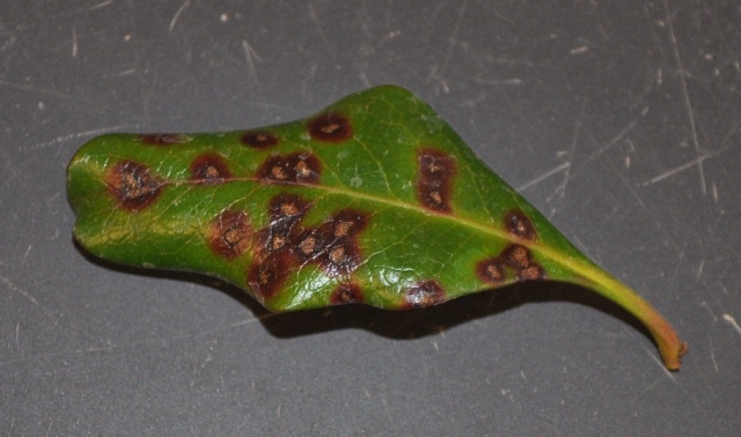
Entomosporium leaf spot on Indian Hawthorn

Brown spots and yellowing on a plant caused by a fungus.
Entomosporium leaf spot on Indian hawthorn
(Photo: NMSU - PDC)
Featured Diagnosis: Entomosporium leaf spot on Indian hawthorn (Rhaphiolepis indica) – Entomosporium leaf spot is a fungal disease caused by Entomosporium sp. It is common on trees and shrubs in the rose (rosaceae) family. It can be particularly troublesome on Indian hawthorn and red tip photinia. In some areas, these shrubs are no longer widely used in the landscape because of their susceptibility to this disease. Other hosts of this pathogen include pyracantha, pear, quince, loquat, and mountain ash. The primary symptom of this disease is the development of reddish-purple spots on the foliage. The fungus produces characteristic “insect-shaped” spores which are diagnostic.

Microscope photo of insect-shaped fungus spores
Characteristic "insect-shaped" spores
of Entomosporium sp. (Photo: NMSU-PDC)

Dark, reddish-purple spots on a leaf.
Leaf spots on Indian hawthorn caused by
Entomosporium sp. (Photo: NMSU-PDC)


Thursday, July 9, 2015

Pink Root on Onions

Onion plants with pink roots
Pink root on onions caused by
Phoma terrestris
(Photo: NMSU-PDC)
Featured Diagnosis: Pink Root on Onions. Onion samples from Southern New Mexico recently submitted to the NMSU - Plant Diagnostic Clinic were infected with a disease known as pink root. Pink root is caused by the soil-borne fungus, Phoma terrestris. This pathogen is common in New Mexico and is problematic worldwide wherever onions are grown. The disease is especially devastating in warmer climates. Although many isolates of this fungus are specific to onion, some have the ability to infect other hosts including tomatoes, soybean, eggplant, pepper, spinach, carrots, small grains, cucurbits, corn and ryegrass.

Microscope photo of a fruiting body with small round spores
Pycnidium and spores of Phoma terrestris
(Photo: NMSU-PDC)
The most noticeable symptom of the disease is the reddish-purple discoloration that occurs on infected roots. In the early stages of the disease, the color change in subtle, but the discoloration darkens as the disease progresses eventually leaving the roots stained dark purple. By the end of the season, infected roots have become dry and brittle and often disintegrate. Roots of infected plants become dysfunctional and plants will suffer from nutrient deficiency and drought. When young seedlings are infected, they may die; however, death is not the end result when more mature plants are infected. In this case, plants are stunted, exhibit leaf tip dieback and bulb size is reduced affecting overall yield and marketability.


Composite photo of onions with pink roots. The plant on the left shows early season symptoms and the photo on the right shows late season symptoms.
Early symptoms (left) and late symptoms (right) of
pink root on onions (Photo: NMSU-PDC)


Monday, July 6, 2015

Summer Heat Brings on Symptoms of Bacterial Leaf Scorch in Chitalpa

Picture of a tree with a lot of dead wood at the branch ends
A chitalpa tree infected with Xylella fastidiosa,
the causal agent of bacterial leaf scorch
(Photo: NMSU-PDC)
Featured Diagnosis - Bacterial Leaf Scorch of Chitalpa. Over the past week, several chitalpa samples have been submitted to the NMSU Plant Clinic exhibiting symptoms of leaf necrosis. Chitalpa trees (a hybrid between catalpa and desert willow) are susceptible to a xylem-limited bacterium called Xylella fastidiosa. The bacterium invades the plant and plugs up the water conducting vessels, known as the xylem vessels, making it difficult for the plant to get enough water to the leaves. The result on the plant is symptoms of water and nutrient stress - chlorosis and leaf scorch. Other symptoms include leaf spotting, small leaves, thin canopy, branch dieback, and eventually, tree death. This disease was first discovered in New Mexico in 2006. It was also confirmed in grapes the same year. In grapes, the disease is known as Pierce’s Disease. In 2010, the disease was also confirmed in catalpa and peach. The disease is transmitted from one plant to another through xylem-feeding insects, most notably sharpshooters. While New Mexico has some native sharpshooters, the most efficient vectors for Xylella, the glassy-winged sharpshooter and the smoke-tree sharpshooter, are not know to occur. 


A composite photograph of chitalpa leaves infected with bacteria. The upper photo show marginal yellowing with brown spots and the bottom photo show large irregular ares of necrosis.
Bacterial leaf scorch symptoms on chitalpa leaves
(Photo: NMSU-PDC)
A composite image of a tree. The photo on the left shows a tree in decline and the photo on the right shows the same tree now dead 3 months later.
Disease progression - the same tree photographed in
August 2006 and October 2006
(Photo: NMSU-PDC)

Thursday, July 2, 2015

Tomato Spotted Wilt Virus Confirmed

A tomato plant exhibiting yellow, deformity and stunting caused by a virus.
Tomato infected with
TSWV (Photo: NMSU-PDC)

Tomato and chile pepper growers should be on the lookout for a potentially significant viral disease called Tomato Spotted Wilt Virus (TSWV). This virus was recently identified in the NMSU Plant Diagnostic Clinic on chile pepper samples from across the state. This virus is commonly identified in New Mexico. It has a wide host range that includes vegetable crops, ornamentals and weeds and it is transmitted by thrips which is a common insect pest. TSWV is an important disease of many different crops grown in temperate and subtropical regions of the world. It is a unique virus in a virus class by itself. The virus has a wide host range, but some of the more common hosts for New Mexico are tomatoes, peppers, potatoes, eggplant, peanuts, lettuce, cucurbits, many legumes, many ornamentals, and weeds such as field bindweed, nightshade, and curly dock. This disease is especially damaging in the ornamental and vegetable greenhouse industry.


A pepper leaf with concentric yellow ringspots.
TSWV on a pepper leaf
(Photo: NMSU-PDC)
A yellow tomato leaf with brown spots on it.
TSWV on tomato leaf (Photo: NMSU-PDC)


A composite photo of fruit infected with virus. The photo on the left is a tomato exhibiting uneven ripening (yellow and red areas intermingled) and the photo on the right is a chile pepper with green and red coloring.
TSWV symptoms on tomato and pepper fruit
(Photo: NMSU-PDC)