Thursday, May 11, 2017

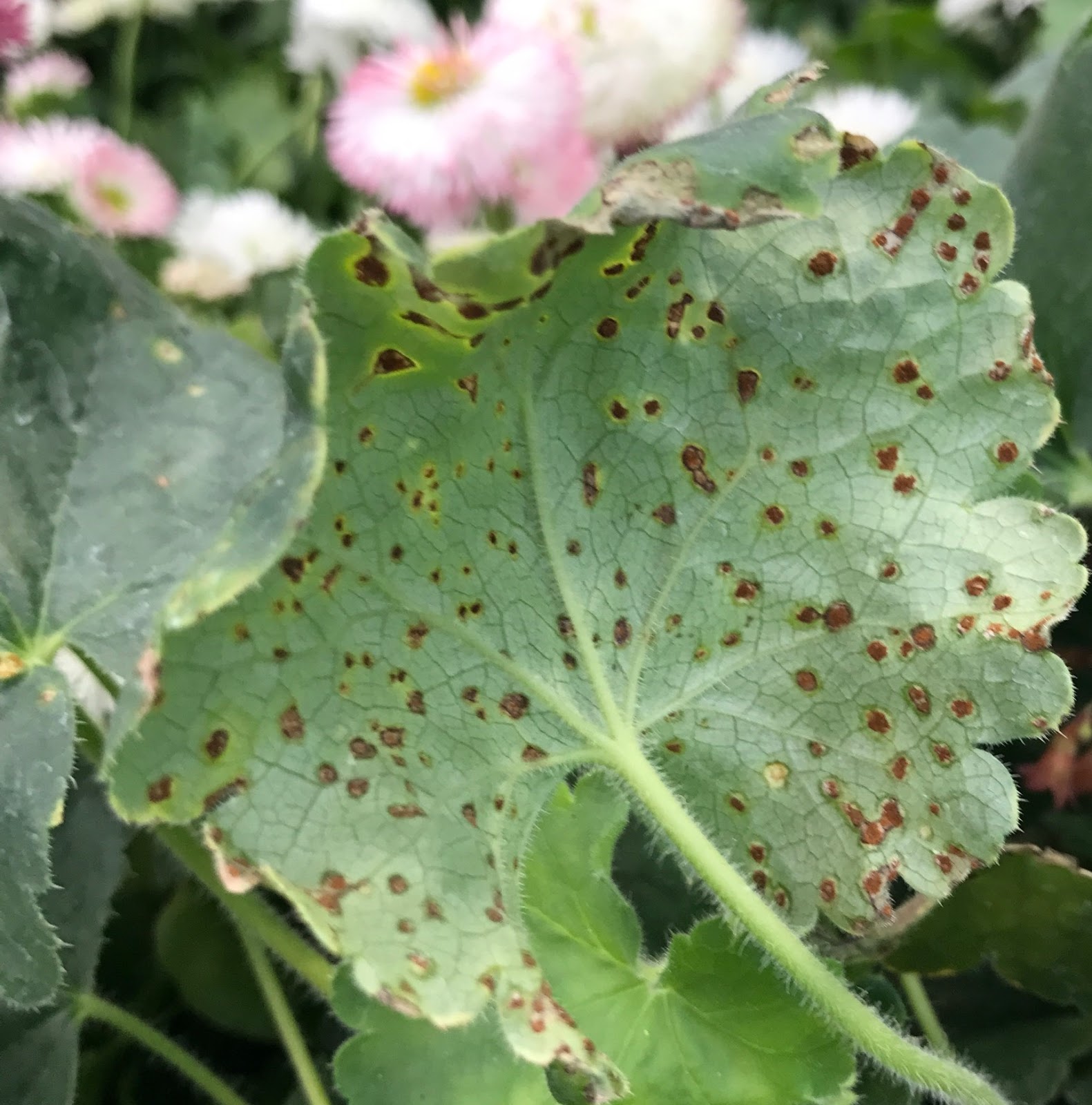
Featured Diagnosis: Heuchera Rust

small brown fungus pustules on the underside of a leaf
Rust pustules on the underside of the leaf
(Photo: J. French, NMSU-PDC)
Rust on coral bells is caused by Puccinia heucherae, which only infects members of the genera Heuchera and Saxifraga. A wide range of plants can be infected by rust fungi, but individual rust fungi have a very limited host range. The most common symptom of rust infection is the production of powdery pustules on the leaves, stems, twigs, flowers and fruit of susceptible plants. Pustules are most common on the lower leaf surface and stem. Pustules may be bright yellow, orange, orange-red, reddish brown, chocolate brown, or black in color. These spots enlarge and may coalesce as the infection builds. Rusted leaves often turn yellow, die, and drop prematurely. Rust fungi infect only the plant’s aboveground parts, and while rust fungi generally do not directly kill their host plants, severe infections ultimately may lead to death by other factors (winter-kill or other diseases). Spores are moved short distances by wind, insects, rain, and animals. Water on the plant surface (aka leaf wetness) is required for spore germination and infection. After the plant is infected, leaf wetness is not needed for continued disease development. Disease builds quickly during periods of high humidity. 


small yellow spots on the upper leaf surface
Rust on the upper leaf surface of
coral bells (Photo: Jason French)


A microscopic photograph of rust spores
Teliospores of Puccinia sp. (Photo: Jason French, NMSU)

Friday, December 2, 2016

Stem and Bulb Nematode Discovered in New Mexico

composite photo showing garlic bulbs with damage from stem and bulb nematode
Figure 1. Garlic plants exhibiting severe symptoms of stem
and bulb nematode (Photo: J. M. French, NMSU-PDC)
Stem and bulb nematode, Ditylenchus dipaci, discovered on Garlic in the Rio Grande Valley of New Mexico - Ditylenchus dipsaci is a serious temperate-climate nematode pest of over 500 plant species in over 40 plant families, including alfalfa, onions, and garlic.  Among plant-parasitic nematodes, it ranks fifth in economic importance and is a quarantine pest of international concern. In 2015, New Mexico harvested 190,000 acres of alfalfa hay with a value of over $188M and is the eighth largest producer of onions in the U.S. cultivating 5,200 acres in that year with a crop value of $91M. These two crops rank number 1 and number 3, respectively, for highest grossing crops in NM in 2015. New Mexico also has a vibrant small farm garlic industry that supplies local markets with fresh garlic and seed for producers.  New Mexico has never reported an infestation of D. dipsaci and its presence could have serious ramifications for NM’s alfalfa, onion, and garlic producers. 

In May of 2015 garlic plants (Allium sativum) from a home garden in were submitted to the Plant Diagnostic Clinic at NMSU.  The grower reported poor growth in ~30% of 1,200 plants originating from seed purchased in southern New Mexico.  Early symptoms included chlorosis, wilting, and poor root and bulb development.  As the disease progressed, roots turned brown, were easily separated from the bulb, and older foliage had collapsed and turned straw colored (Figure 1).  Microscopic examination showed large numbers of nematodes present in symptomatic garlic plants. Based morphological characteristics of the nematode and the DNA sequence of the ITS-1 region, the nematodes were identified as D. dipsaci.

This discovery is highly significant as this nematode has the potential to cause significant economic losses on agriculturally important hosts grown in the state and in the region. The longevity of this pest in the soil and international trade issues are major concerns for producers. Based on information from the grower it appears that this is an isolated introduction from infested plant material which can potentially be contained as the presence of D. dipsaci was discovered before any material was harvested or distributed. Monitoring of production areas in the state will be performed to determine if this was an isolated and contained introduction or if this important pest has become established in NM.
 
microscopic photograph of a stem and bulb nematode from a garlic plant
Stem and bulb nematode isolated from garlic
(photo: J. Beacham, NMSU)

Friday, October 7, 2016

Plant Clinics in Albuquerque this Weekend

Specialist's from the NMSU - Plant Diagnostic Clinic will be holding plant clinics this weekend in the Albuquerque area. We will be at the Downtown Growers' Market on Saturday morning from 8 AM- 11:30 AM and at the Local Food Festival at the Gutierrez - Hubbell House on Sunday from 10 AM - 2 PM. Please come and visit us! If you have a problem plant or pest, bring it along, we'll do our best to identify the problem and provide information on management options! (The photo below is from the plant clinic at the Local Food Festival two years ago). Hope to see you there!

Photo of NMSU employees at the Local Food and Field Festival in Albuquerque, NM in 2014
NMSU Faculty at the Local Food Festival in Albuquerque in 2014

Wednesday, September 21, 2016

Tomato Spotted Wilt Virus Strikes Again

A chile pepper plant with leaf deformity, spotting and yellowing caused by a virus
Chile plant exhibiting symptoms of Tomato
Spotted Wilt Virus (Photo: NMSU - PDC)
We've highlighted this disease before, but it's such an interesting disease that we decided to do it again! This chile plant was submitted for disease analysis exhibiting classic symptoms of Tomato Spotted Wilt Virus (TSWV). Symptoms of TSWV can be quite variable, but some of the more common symptoms include leaf deformity (especially of the new growth), terminal necrosis, leaf drooping (wilt-like appearance), stunting, mottling, and spotting (necrotic and chlorotic). In this particular case, several leaves on the plant displayed characteristic chlorotic spots with concentric rings (see images below).  Fruit symptoms can also be quite striking. Fruit symptoms include: chlorotic concentric ringspots, raised bumps, uneven ripening and deformity. Plants infected early in the season may produce little or no fruit. In this case, the plant produced only one small, deformed fruit which ripened prematurely. Most viral diseases are confirmed using some form of DNA analysis. In this case, there is an antibody-antigen test that can detect the virus in just a few minutes. A small amount of plant tissue is ground in buffer and then a strip embedded with antibodies to the virus is placed in the sap solution. If the virus is present, two purple lines appear on the strip (if only one line appears, it indicates that the test worked, but the virus was not present). Below is a photo of the antibody-antigen test for this plant.


The terminal branches of a chile plant with leaf curling and deformity caused by a virus
Terminal leaf deformity caused by Tomato Spotted
Wilt Virus (Photo: NMSU-PDC)

A composite photo of chile pepper leaves with chlorotic concentric ringspots caused by a virus
Chile pepper leaves exhibiting chlorotic concentric ringspots characteristic
of TSWV (Photo: NMSU-PDC)

A plastic sample bag with a crushed up chile peper leaf and an indicator stick showing the leaf sample is infected with a virus
Antibody-antigen test results for Tomato Spotted Wilt Virus -
two purple lines indicated that the tissue is infected
with Tomato Spotted Wilt Virus (Photo: NMSU-PDC)

Tuesday, September 13, 2016

Tubakia Leaf Spot

Tubakia Leaf Spot

Oak leaves with irregular brown spots caused by a fungus
Tubakia leaf lesion on Oak.
Tubakia sp. a fungal pathogen that causes a late season leaf spot and twig canker. All species of oak appear to be susceptible to the disease but those in the red oak group ( black, red & pin oak) appear to be most susceptible.

Tubakia leaf spot tends to develop in the late summer to early fall and begins as small reddish-brown foliar spots. As the disease progresses the leaf spots enlarge and may coalesce to form large blighted areas. Spotting may occurs on or near leaf veins causing death of the vein and collapse of leaf tissue beyond that point. Premature leaf drop and small twig cankers can form in severe cases.

Tubakia sp. overwinter in twig cankers and in infected leaf tissue on or around the tree. Spores are easily spread by wind and rain splash to uninfected tissue in the spring and early summer months. In most cases, Tubakia leaf spot is a cosmetic disease. In general, when leaf spots are sporadic, the ultimate damage to the plant is relatively insignificant. When leaf spots occur year after year on the same tree, cumulative damage may result in dieback and decline.

Management of Tubakia begins with good sanitation practices such as raking and destroying fallen leaves. This reduces the initial inoculum for the following year. Selectively pruning branches to increase air circulation within the tree canopy will further reduce the incidence and severity of the disease. Branches exhibiting cankers or dieback should also be removed from the tree. This will improve the appearance of the tree as well as reduce overwintering sites for the pathogen. Lastly ensuring that the tree is properly cared for (irrigation and fertility programs) will reduce plant stress and decrease susceptibility to the disease.

Close up of irregular brown spots on an oak leaf caused by a fungus
Tubakia sp. causing leaf vein death and
collapse of leaf tissue beyond that point.
Oaks leave dying and turning light brown due to fungus infection
 Advanced stages of Tubakia leaf spot note coalescing
lesions, twig cankers and premature defoliation.


Microscopic photograph of fungus spores
The conidia (dark, ovoid structures pictured here) are produced
by the fungus and serve as inoculum for new infections.


Thursday, June 16, 2016

Tomato Psyllids

picture of tomato psyllid adults and nymphs
Tomato psyllid adults and nymphs (Photo: NMSU-PDC)
Featured Diagnosis: Tomato (Potato) Psyllids - Hemiptera, Psyllidae, Bactericera cockerelli.


These tiny insects will attack a wide range of hosts but prefer solanaceous plants like tomato, potato, peppers, and eggplant. Published reports indicate that yellow pear tomato is especially susceptible to tomato (potato) psyllids. The infestation pictured here began on a yellow pear tomato and quickly spread to several other tomato varieties. Psyllid eggs are laid on stalks on the under side of the leaves. Nymphs hatch from the eggs and are flattened, oval and yellowish green to orange with red eyes and three pairs of legs. They develop through five instars before becoming adults. Adult psyllids are ~3mm long have white to yellowish markings and clear wings. Psyllids feed most often on the underside of the leaves. While feeding, the insect injects a toxin into the plant. The toxin causes a variety of symptoms which collectively are commonly referred to as “psyllid yellows.” These symptoms include stunting, yellowing, and curling of the leaves. Plants damaged by psyllids may produce little or no fruit. Fruit that is produced is often small, even in large-fruited varieties, and of poor quality. Small seedlings or transplants may be killed by the insect. 


A composite photo of tomato plants infested with small insects called psyllids
Tomato psyllids on leaves and stems of tomato plants (Photos: NMSU-PDC)


tomato plant in a pot with psyllid insects feeding on it
Tomato psyllid infested tomato plant (Photo: NMSU-PDC)


Wednesday, June 15, 2016

Tomato Spotted Wilt Virus on Dahlia

Dahlia plant with yellow flecking on the leaves caused by a virus
Tomato Spotted Wilt Virus on dahlia - note
the yellow flecking near the tip of the leaf
(Photo: NMSU-PDC)
Featured Diagnosis: Tomato Spotted Wilt Virus is a common virus with the ability to cause disease on a wide range of hosts. In New Mexico, it is often found on peppers and tomatoes. Recently, the virus was identified on dahlia. Dahlia is a known host for this pathogen, but this is the first report of the disease on dahlia in New Mexico. The symptoms on the dahlia samples submitted to the NMSU Plant Diagnostic Clinic were subtle; a yellow flecking on some of the leaves.


Friday, May 20, 2016

Hail pounds parts of Dona Ana County

Photo of a street in Las Cruces, NM with hail all over the ground
Hail in Las Cruces on May 18, 2016
On May 18, 2016 a storm moved through Dona Ana County dropping pea to marble sized hail. In some locations, crops and garden plants sustained significant damage from this storm. In addition to the physical injury created by the hail and wind, the plants are now vulnerable to infection by fungi and bacteria that can take advantage of the wounds. In some situations, the use of fungicides/bactericides may be helpful in preventing or reducing additional losses to these organisms.


A composite photo of an onion field - the photo on the leaf shows a good stand of healthy plants, the photo on the right show the same field 2 days later after a hail storm that removed much of the foliage
Onion field one week before hail storm (left) and 2 days after hail storm (right)
(Photos: Jason French, NMSU - PDC)

Composite photo of a grape vineyard showing tattered leaves and pock marked fruit caused by hail
Hail damage on grapes - approximately 30% of the grapes at the
Fabian Garcia Ag Science Center were damaged by the storm
(Vine photos: Jason French, NMSU - PDC;
Fruit photo: Daniel Goodrich, NMSU - Viticulture Program)

A composite photograph showing tattered pecan leaves damaged by hail
Pecan leaves damaged by hail (Photos: Jason French, NMSU - PDC)

A composite photo of a tomato leaf - the photo on the left was taken immediately following the hail storm and show holes in the leaf, the photo on the right was taken of the same leaf 3 days later and shows the leaf starting to die and developing necrotic tissue
Tomato leaf damaged by hail: photo on left was taken immediately
following the hail storm and the photo on the right, of the same leaf, was
taken 3 days later (Photos: Natalie Goldberg, NMSU - PDC)

Green tomato fruit with light green spots where hail hit the fruit
Hail damage on tomato fruit
(Photo: Natalie Goldberg, NMSU - PDC)
Garden sage with holes in the leaf caused by hail
Hail damage on sage
(Photo: Natalie Goldberg, NMSU - PDC)


Monday, May 16, 2016

First Detector Training & Field Pest Identification Workshops Offered by NMSU's Cooperative Extension Service

The educate to detect logo

NMSU's Cooperative Extension Service is offering two plant health workshops the first week of June in Albuquerque. On June 7, there will be a First Detector Training Workshop for Master Gardeners, Pest Control Operators, landscape managers, crop producers and the general public. This training is part of the National Plant Diagnostic Network's education and training program. Participants who attend the training workshop will become a Certified First Detector and be part of a national registry of trained first detectors. The training will be conducted at the Albuquerque Garden Center from 8:30 AM - 3:00 PM. The cost for this is $20 - morning coffee and refreshments, and lunch is provided.
On June 8, there will be a Field Pest Identification Workshop which will allow participants to learn the process of identifying pest problems in the field. This hands-on training will be held outdoors at the Hubble House from 9:00 AM - 11:30 AM - participants are advised to dress appropriately and the bring a hat and sunscreen. This event is free - light refreshments and water will be provided.
The deadline to register for either or both of these events is June 1. For more information on these events, please view the Registration Form 

Photo of three people standing under a tree
Three newly certified First Detector's proudly
display their First Detector Field Packs 

Photo of a classroom with a crowd of people
First Detector Training Class

Photo of a group of people in a garden looking at plants
Master Gardeners participating in a pest ID workshop

Friday, May 13, 2016

NMSU Plant Clinic Assists with Pest Identification

Spring has sprung and the plant are growing! If your plants start to look stressed, test, don't guess! Symptoms alone are usually insufficient for diagnosis, because they are not specific to the causal agent. Proper identification is important in developing management plans. The NMSU Plant Diagnostic Clinic is here to help. We can assist with disease, arthropod and weed identification. Submission of samples for diagnosis is facilitated through the County Extension Agents. Check here for the location of NM County Extension Offices

A composite photo of four plants with different diseases that looks similar to one another
Test, don't guess! Symptoms caused by pathogens may look alike.
They are not specific to the causal agent!

Thursday, November 12, 2015

Fall Rainfall an Indicator of a Potentially Significant Curly Top Outbreak Next Year

Photo of London rocket plant with deeply lobbed leaves
London rocket (Sisymbrium irio) (Photo: N. Goldberg, NMSU)
Picture of chile plants in the field with some of the plants stunted and yellow
Beet Curly Top Virus  on chile peppers
(Photo: N. Goldberg, NMSU)
A wet fall, especially rainfall in October, helps to germinate winter annual weeds. Some of these weeds, particularly those in the mustard family, such as London rocket (Sisymbrium irio), provide an excellent overwintering habitat for the curly top insect vector, the beet leafhopper (Circulifer tenellus). Some of these weeds are also asymptomatic hosts for the Beet Curly Top Virus. Studies at New Mexico State University have shown that severe outbreaks of Beet Curly Top Virus occur in years  with excessive rain the preceding October. Within the last couple of weeks, huge populations of London rocket have developed in Dona Ana County (and probably most other counties in New Mexico). This weed can germinate in high numbers such that it appears like a ground cover. A significant effort to eliminate these weeds now, while they are small, should help to reduce the overwintering sites for the beet leafhopper and subsequently reduce the potential for Beet Curly Top Virus next year.


A composite photo - the photo on the leaf shows a high number of London rocket plants, the photo on the right is a close up of the plant
London rocket (Sisymbrium irio) in an empty lot
 (Photo: N. Goldberg, NMSU)

A dense population of London rocket plants growing along a roadway
A dense population of London rocket growing along
a roadway (Photo: N. Goldberg, NMSU)
A dormant alfalfa field in winter is covered with a dense population of London rocket plants
London rocket in an alfalfa field in the middle of winter
(Photo: N. Goldberg, NMSU)
A composite photograph showing a beet leafhopper from the top and from the side
A beet leafhopper (Circulifer tenellus), the insect vector of the
Beet Curly Top Virus (Photo: J. Shaughney, NMSU)


A composite photo of different plants infected with a virus - top left is beans, top right is pumpkin, bottom leaf is spinach, and bottom right is tomato
Beet Curly Top Virus on bean (upper left), pumpkin (upper right),
spinach (lower left), and tomato (lower right)
(photos: N. Goldberg and J. French, NMSU)

Tuesday, October 13, 2015

NMSU's Extension Service to Hold Plant Clinics in Belen and the Albuquerque Area

Specialist's from the Extension Plant Sciences Department will hold plant clinics at the Belen Growers' Market and two growers' markets in the Albuquerque area this coming weekend. Please come see us at one of the following locations and don't forget to bring your problem plants and insects for identification!

On Friday evening, October 16, the group will be present at the Belen Growers' Market located at Anna Becker Park, on Hwy 309 and Reinken Ave. The market begins at 4:30 PM.  The question-and-answer session will be hosted by four specialists: Carol Sutherland, entomologist; Leslie Beck, weed scientist, and Jason French and Natalie Goldberg, who are experts on plant diseases and disorders. In addition, the county Extension agent, Newt McCarty, will be available to help answer questions.

Advertising flyer for the Belen Growers' Market Plant Clinic
Belen Growers' Market Plant Clinic Flyer
On Saturday morning, October 17, the group will divide into two and provide plant clinics at two Albuquerque area growers markets. Leslie Beck, Jason French and, Bernalillo County Horticulture Agent, Graeme Davis, will be at the Los Ranchos Growers' Market located at 6718 Rio Grande Blvd. NW starting at 8:00 AM. Carol Sutherland, Natalie Goldberg, and Bernalillo County Agriculture Agent, John Garlisch, will be at the Downtown Albuquerque Growers' Market located at Robinson Park starting at 8:00 AM.
Advertising flyer for the Downtown Growers' Market Plant Clinic
Downtown Albuquerque Growers' Market Plant Clinic Flyer
Advertising Flyer for the Los Ranchos Growers' Market Plant Clinic
Los Ranchos Growers' Market Plant Clinic Flyer

Monday, October 12, 2015

Common Pests of Sunflowers

Sunflowers are garden favorites for their festive flowers and tasty seeds---that is, until some common insect pests hijack them.

Sunflower Moth
If a sunflower head looks distorted or ‘dirty’ with webbing and gritty beads on it, it could be infested with larvae of the sunflower moth, Homoeosoma electellum. The larvae consume the developing seedsas well as contaminate the entire head with their silk and frass (poop); this, in turn creates a great environment for fungus growth.

Picture shows a black and green sunflower moth larvae
Sunflower moth larvae, Homoeosoma electellum.
(Photo: C. Sutherland NMSU)


Sunflower Stem Borer
The hatchling ‘sunflower stem borer,’ Dectes sp., bores into the pith of its host, weakening the plant and/or the flower stem. Parts of affected plants may wilt permanently, or entire plants may flop over in the wind. This particular larva is the immature stage of a ‘long horned beetle’---NOT a caterpillar.

Picture shows a white larvae of a sunflower stem borer
Sunflower stem borer larvae Dectes sp.
(Photo C. Sutherland NMSU)
For more information about theses sunflower pests please contact Dr. Carol Sutherland.

Tuesday, October 6, 2015

NMSU's Extension Service to Host Plant Clinics in Lordsburg and the Mimbres Valley

New Mexico State University’s Extension Plant Sciences department will host a Plant Clinic at several farmers’ markets this summer and fall, to help educate the community about horticultural practices and pest management, including identification of insect, weed, and disease problems.

“We encourage anyone who is interested in gardening and has a question that they have not been able to get answered, to come out and visit with us,” said Natalie Goldberg, department head of NMSU’s Extension Plant Sciences. “If they have problem plants or pests that they would like to have identified, they are encouraged to bring us a sample of the plant or pest.”

The question-and-answer sessions will be hosted by three specialists: Carol Sutherland, Extension Entomologist; Leslie Beck, Extension Weed Scientist, and Goldberg, Extension Plant Pathologist. In addition, the county Extension agent will be available to help answer questions.

“Some problems people bring to the clinic might be resolved on the spot, but others might need more background information to complete an answer, so we’ll make sure we have the client’s contact information and specific question written down so we can contact them later,” said Sutherland, who will have a collection of insects on display for additional questions.

Goldberg added they hope to answer most questions but if they can’t, they will either take back samples for further analysis or connect clients with other experts.

“Plant Clinics are a great way to interact with people not familiar with the great variety of information available through the Cooperative Extension Service,” Sutherland said.

Advertising flyer for Hildago plant clinic
Flyer for farmers' Market plant clinic in Lordsburg, NM

Advertising flyer for the Mimbres Valley Harvest Festival
Flyer for Mimbres Valley Harvest Festival plant clinic


Tuesday, September 29, 2015

Shepherd’s purse (Capsella bursa-pastoris)

Picture of weeds
Shepherd’s purse (Capsella bursa-pastoris) infestation
(Photo L. Beck NMSU)
Featured Diagnosis: Shepherd’s purse (Capsella bursa-pastoris) is a weed that has become well-established throughout the state of New Mexico. Though this weed is generally considered to be a winter annual, its’ ability to tolerate a wide range of temperatures often allows for germination and growth at multiple points throughout the year. Germination generally occurs in the late summer, early autumn, and even in the early spring depending on temperatures and moisture. It can be found in multiple cropping systems including nursery, agronomic and vegetable crops, landscape, horticulture, and roadsides.

The plant initially grows as a basal rosette with leaves that closely resemble those of dandelion as the plant matures. One way to distinguish shepherd’s purse rosette leaves from dandelion is to look at the teeth points on the outer edges (margins) of the leaves. The margin teeth of dandelion tend to point downwards towards the center of the rosette while shepherd’s purse teeth tend to be more rounded when young, and become larger and more deeply toothed (pointed straight) as they mature. 

Additionally the leaves of the shepherd’s purse tend to be smooth to lightly hairy on the top and hairy on the bottom. As the plant matures it forms erect, slender stems that hold the small white flowers and unique fruit pods anywhere from 3 to 18 inches up in the air. The fruit (or seed pods) generally appear from April to September, though temperatures often allow for seed production throughout the year. Fruits are easily identifiable as a triangle-heart-shaped, 2-chambered (separated by a dividing line down the middle), flattened pods that hold numerous seed per chamber. Each plant can produce thousands of dull reddish to yellowish seed capable of surviving for multiple years in the soil.

The fruit can taste peppery and is sometimes added to salad greens as a spice; however, foliage and seeds contain digestive irritants which can cause stomach problems when consumed in higher quantities. Management options like repeated cultivation to prevent seeds from maturing, and manually removing plants (including the shallow taproot) before they produce viable seed, can help maintain small populations in gardens and landscapes. While the rosette foliage might be confused with other members of the mustard family, the flat, heart-shaped pods easily distinguish shepherd’s purse from its’ mustard relatives.

Picture of a shepherd's purse plant with lobbed leaves
Shepherd’s purse (Capsella bursa-pastoris) rosette stage.
(Photo: L. Beck NMSU)
Picture of shepherd's purse plant with a seed stalk
Shepherd’s purse (Capsella bursa-pastoris) pressed
specimen. (Photo L. Beck NMSU)

Picture of heart shaped fruit of shepherd's purse plant
Shepherd’s purse (Capsella bursa-pastoris)
fruit (Photo L. Beck NMSU)
Flower stalk of shepherd's purse plant
Shepherd’s purse (Capsella bursa-pastoris)
inflorescence. (Photo L. Beck NMSU)